
How do climate extremes affect ecosystems in the Coorong, Lower Lakes and Murray Mouth (CLLMM)?
Droughts, floods, heatwaves and storms are climate extremes that are becoming more frequent and intense due to climate change.
A lot of climate change research has focused on how ecosystems respond to gradual climate shifts, like increasing temperature and ocean acidification. But we now know that extreme climate events, like droughts and floods, can act alongside long-term climate change to shape ecosystems. Some species can respond to climate change by adjusting their behaviour, physiology, geographic range, and other characteristics. But when conditions shift quickly, like in drought or flood, their capacity to change is limited. Some species in the ecosystem may thrive during an extreme event, while others collapse.
How do ecosystems reorganise after extreme climate events?
While we have some idea of how a single species or ecosystem might respond to these events, we don’t yet fully understand what drives the collapse and recovery of inter-connected aquatic ecosystems like the Coorong, Lower Lakes and Murray Mouth.
The Climate extremes project team set out to change this. To help understand how ecosystems reorganise after extreme climate events, the team reviewed all of the research published on ecosystem responses to droughts and floods in CLLMM over nearly four decades (1987-2025).
Their review included 64 studies on how living organisms respond to climate extremes (e.g. birds, fish, turtles, frogs, vegetation, benthic invertebrates, plankton and microbes) as well as the changes in physical and chemical environmental variables (e.g. water level, salinity, temperature, dissolved oxygen, nutrients, turbidity and hydrological connectivity).
Drought caused the most extensive and persistent ecological change.
In their review of the literature, the team found that in drought:
- waterways disconnect
- habitat is lost
- water quality decreases
- food webs simplify
- biodiversity is lost
- salinity increases
- sensitive species are lost.
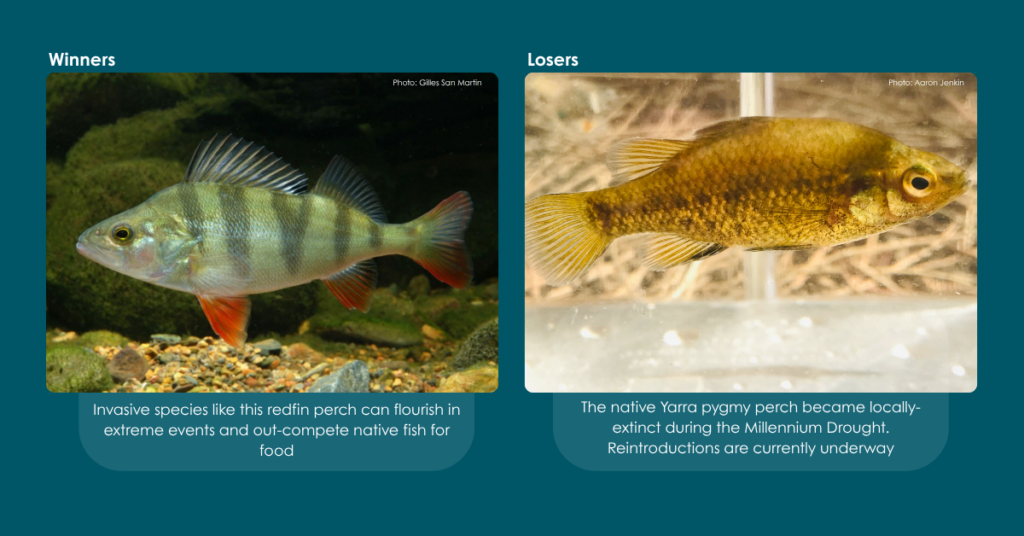
Specialist and connectivity-dependent fishes declined during drought, while salinity tolerant generalist and invasive fishes dominated.
Floods were described as periods of partial recovery, but they did not always reverse drought-driven ecological change.
The literature review found that floods:
- restored waterway connectivity
- decreased salinity
- redistributed nutrients
- increased biodiversity
- increased habitat availability
- enabled recruitment and recolonisation of fishes, invertebrates, and macrophytes
- helped invasive species dominate.
The ecosystem’s response to floods was influenced by past impacts of drought, like depleted seed banks and increase of invasive fishes.
In extreme conditions, whether drought or flood, resilient species that use many habitats or foods can thrive. Invasive species often fit into this category. Sensitive species that rely on specific habitats or foods will suffer. Endangered species often fit into this category.
How can we protect CLLMM ecosystems from future floods and droughts?
The Climate extremes project has given us a better idea of how the region’s ecosystems will respond to drought and flood in the future. Their review has highlighted how important it is to:
- make sure waterways stay connected
- protect aquatic plants, birds and native fish
- control invasive species.
These actions are vital to help protect CLLMM ecosystems and increase their resilience as climate extremes intensify.
After the team completed their review, they brought together a diverse group of people who have experienced climate extremes in the region, from landholders and First Nations to SA Water and Department of Environment and Water personnel.
Together, they reflected on the review’s findings, shared their experience with extreme climate events, and workshopped ways to help the region prepare for future climate extremes.
The team is now preparing a report on the workshop, with recommendations for future work that will help protect the region’s unique ecosystems.
For more information visit Climate Extremes Project Page.